

Whole Fruit or Fruit Juice: What Changes?
Everyday guidesPublished 4 min readcomparison
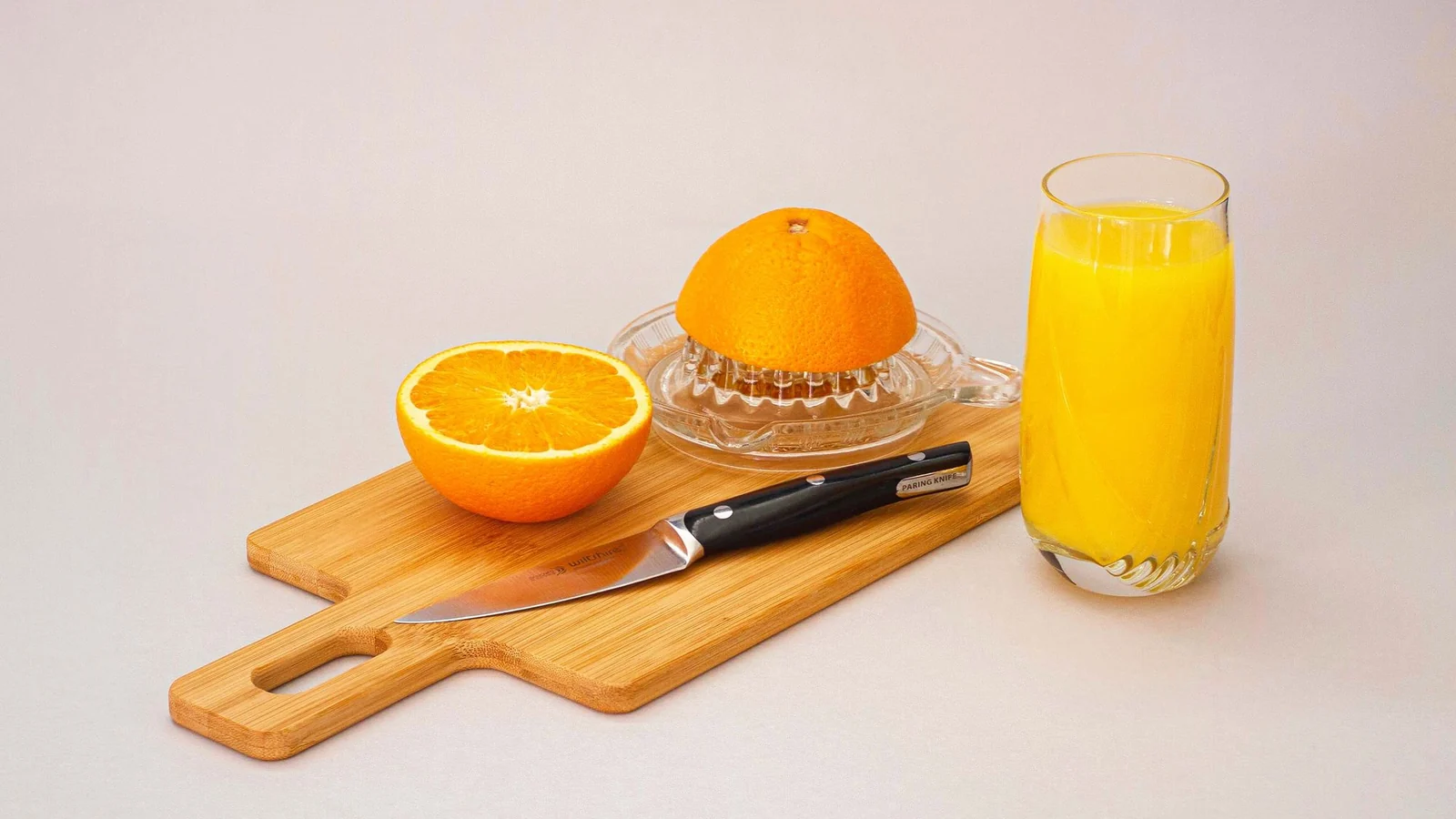
Compare a piece of fruit, juice and a smoothie without treating every fruit-based drink as the same food.
Illustrative licensed stock photograph; no depicted person is identified as a customer or product user. · Photo: Rae Wallis · pexels.com
The short answer
Choose whole fruit regularly rather than replacing it with large glasses of juice. Juice and smoothies have different portions and handling needs, and “no added sugar” does not mean sugar-free. NHS guidance limits juice and smoothies together to 150 ml a day, preferably with a meal.
Table of Contents
- Make whole fruit a regular option
- A large glass is still a large portion
- Read the description beyond “fresh”
- Is a smoothie the same as whole fruit?
- Keep food safety in the decision
- An easy café decision
- Sources
- Explore this topic
A café menu offers orange slices, fresh juice and a fruit smoothie. They all start with fruit, but the choice still matters: how much you receive, what has been added and whether you are ordering food or a large drink.
You do not need to avoid fruit to make a more deliberate choice. Start with the portion and the form, then check the ingredients and how the item is prepared.
Make whole fruit a regular option
Whole fruit can be cut up; it does not have to mean eating an entire large papaya in one sitting. Choose a portion that fits your meal and preferences. Fresh, frozen and suitable canned fruit are all options in the NHS food-group guidance.
For a practical breakfast choice, order a portion of fruit you enjoy alongside the rest of the meal. There is no need to rank every fruit as “good” or “bad” or assume that a green-coloured drink is automatically a better option.
A large glass is still a large portion
NHS guidance treats juice and smoothies as a combined category limited to 150 ml a day, consumed with meals to reduce the impact on teeth. That is a portion guide, not a claim that 151 ml suddenly becomes dangerous.
As an arithmetic example, a 450 ml glass holds three 150 ml measures. Ice and dilution complicate the amount of actual juice, so ask about the recipe rather than estimating from a photograph. The example describes volume only; it does not assign calories or sugar to a particular café drink.
At home, measure your usual glass once if you are unsure what the serving looks like. That may be more useful than trying to judge every drink by the height of its container.
Read the description beyond “fresh”
| Menu or label wording | What remains worth checking |
|---|---|
| Freshly squeezed | Portion size and how it is handled |
| No added sugar | The drink can still contain sugars from fruit |
| Smoothie | All ingredients, including syrups, juice bases or sweetened yogurt |
| Fruit drink or nectar | Fruit content and the full ingredient list |
| Whole-fruit bowl | Portion and any sweetened toppings |
Do not assume the answer from the name alone. A simple question such as “Is this only fruit and water, or is syrup added?” gives more useful information than asking whether the drink is healthy in the abstract.
Is a smoothie the same as whole fruit?
A smoothie can retain more of the original fruit material than a strained juice, but it is still easy to combine several ingredients into one large drink. The NHS portion guidance above includes both. A blended drink does not become unlimited because you can see seeds or pulp.
If you make one yourself, write down what goes into the blender and how many portions you pour. For example, a recipe intended for two people should not silently become one serving just because it fits a large cup. You can pair a smaller drink with food instead of asking it to replace an entire meal by default.
For more on the role of different fibre types, see soluble and insoluble fibre. This comparison is about everyday choices, not a personalised plan for diabetes or another medical condition.
Keep food safety in the decision
“Fresh” does not mean treated to remove harmful microbes. The FDA explains the risks of untreated juice, particularly for pregnant people, older adults and people with weakened immune systems. Ask how a juice has been processed when that matters for your needs; colour and taste cannot verify safety.
For whole fruit, use safe preparation too. FDA produce guidance advises washing under running water without soap, using clean hands and equipment, and keeping pre-cut produce refrigerated. In accommodation, first establish that the water used for food preparation is suitable for that purpose.
An easy café decision
Choose the food you actually want. If you want fruit, a portion of whole or cut fruit is a straightforward option. If you want juice, ask for a modest portion with the meal and check additions rather than treating a large glass as compulsory hydration.
Is juice forbidden? No. Portion guidance is a way to fit it into the day, not a moral judgment about a drink.
Does no added sugar mean no sugar? No. It describes additions, not the absence of sugars already present in the ingredients.
Must fruit be fresh? No. Our fresh versus frozen produce guide explains related storage and convenience considerations without assuming one format always wins.
Instructions & useful references
- 5 A Day: what counts?NHS · Combined 150 ml juice/smoothie limit; mealtimes; whole, frozen and canned options
- What you need to know about juice safetyFDA · Untreated juice can transmit illness; higher risk groups; ask about treatment
- Selecting and serving produce safelyFDA · Wash produce with water, not soap; safe preparation; refrigerate pre-cut produce
Sources checked on September 27, 2026. This guide provides general information, with practical planning suggestions. It is not an individual treatment plan.