

Progressive Overload When You Cannot Add More Weight
Everyday guidesPublished 6 min readhow to
1:35 · English narration Continue reading the article ↓
Video chapters
Read the video transcript
Your gym's heaviest dumbbell is no longer challenging. Use a repeatable progression log before adding random exercises, rushed sets or endless repetitions.
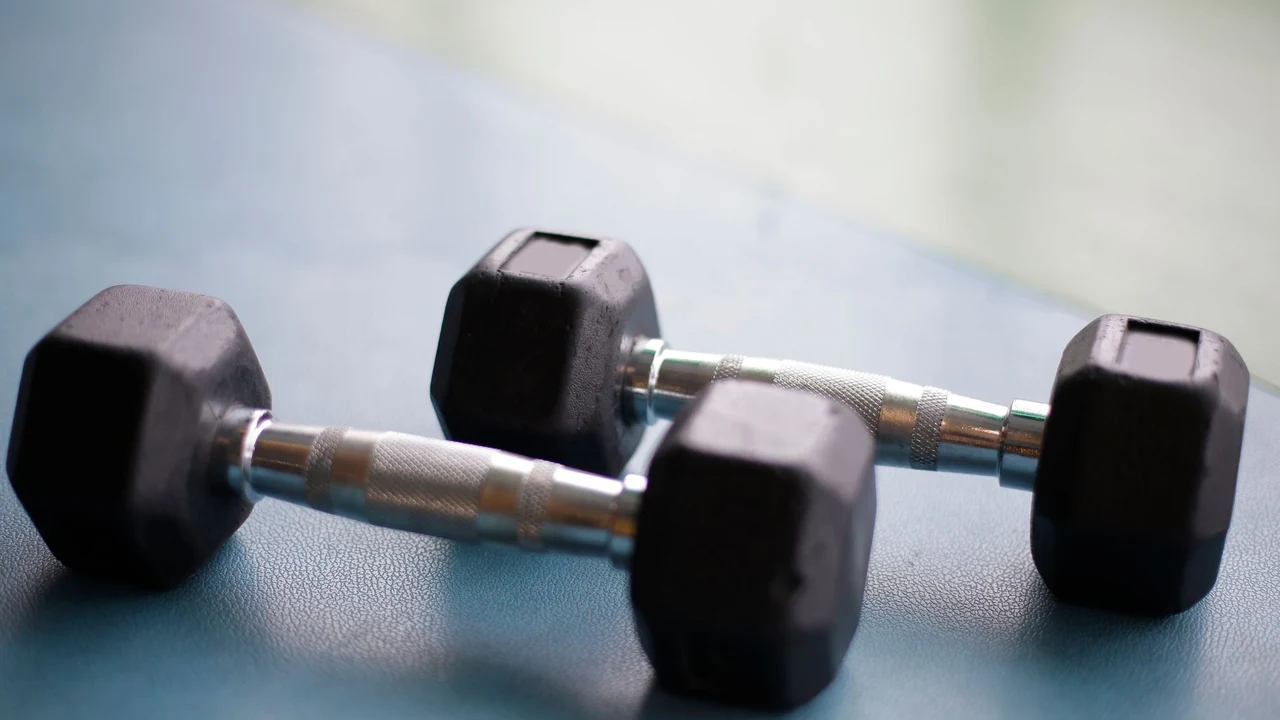
Your hotel gym has no heavier dumbbells. That does not make the next session pointless. Progress can include more controlled repetitions with the same weight. Start by making today's sets comparable with last time.
Record the exercise, weight, repetitions, rest and effort. Ten repetitions with a shorter movement or more swinging are not the same task as ten controlled repetitions. Keep technique consistent before calling a change progress.
Here is an example, not a prescribed programme. Last time: ten, ten and nine repetitions. Next time: ten, ten and ten, with the same setup. That is one additional repetition you can actually identify.
Once repetitions become easy, review the next option: an appropriate extra set, a suitable exercise variation or better equipment. Do not add all three together. A different variation needs its own starting point in your log.
Cutting every rest period may make the session feel harder while reducing the work you can perform. More breathlessness is not proof of more muscle stimulus. Pain or worsening technique calls for adjustment, not another challenge.
For your next session, choose one familiar exercise and write down a repeatable baseline. Progress within your ability and recovery. The full guide includes a simple decision table for when the available weights stop being enough.
Download transcript · English captions · Footage and production credits
Illustrative Pexels footage, original explanatory graphics and music, with synthetic English narration. People shown do not endorse products.
Your gym's heaviest dumbbell is no longer challenging. Use a repeatable progression log before adding random exercises, rushed sets or endless repetitions.
The short answer
Progressive overload can involve more repetitions at the same load, not only a heavier weight. Keep the exercise, range of motion, rest and effort comparable, then change one variable deliberately. Limited equipment eventually has limits; making a workout more exhausting is not automatically the same as improving the training stimulus.
Table of Contents
- Start by defining what stayed the same
- Does adding repetitions actually work?
- Try a repetition ladder you can explain
- What to change after repetitions
- Why shorter rests are a different decision
- Use tempo as a description, not a magic multiplier
- Know when the equipment is the limitation
- Sources
- Explore this topic
The heaviest dumbbell in the hotel gym is the one you used last week. Your programme says “progressive overload,” so it seems you have reached a dead end.
You still have options. Adding repetitions while keeping the weight fixed can be a legitimate progression. The challenge is to change the demand without making the comparison meaningless. A rushed set, a shorter movement and a new exercise are not interchangeable ways to record the same improvement.
Start by defining what stayed the same
Illustrative licensed stock photograph. · Photo: Andrea Piacquadio · pexels.com
View full size ↗Suppose you log “dumbbell row: 12 kg, 12 reps.” That entry leaves several questions unanswered. Was it the same arm? The same support? Did you pull through a similar range? How long had you rested? Were the last repetitions controlled, or did you rotate your whole body to finish?
You do not need a laboratory notebook. You need enough detail to recognise the task next time. Keep a line for the exercise and setup, load, repetitions in each working set, approximate rest and how much effort the final repetitions required.
If your whole routine is still changing every visit, first choose a manageable structure. Our two-day strength-training guide explains how to make the weekly sessions repeatable.
Does adding repetitions actually work?
A randomized study by Plotkin and colleagues compared increasing load with increasing repetitions at a fixed load over eight weeks. Participants were young adults with resistance-training experience; the supervised programme trained the quadriceps and calves. Both approaches were viable ways to improve the measured muscular adaptations.
That is useful evidence for having more than one progression tool. It does not prove that a light dumbbell will remain sufficient forever, that every exercise responds identically, or that repetition progression replaces practising heavy lifting when heavy-lift performance is your goal.
The practical distinction is between progressing a task and choosing a task appropriate to your goal. You can improve at many repetitions with a light weight without developing exactly the same skill as lifting a much heavier weight.
Try a repetition ladder you can explain
The table below is a fictional training log, not a recommended set count, load or timetable. It shows what a small, traceable change looks like.
| Visit | Same exercise and load | Repetitions | What changed? |
|---|---|---|---|
| First | Familiar movement with a suitable load | 10 / 10 / 9 | Baseline |
| Later | Same setup, range and rest | 10 / 10 / 10 | One additional repetition |
| Later again | Same conditions | 11 / 10 / 10 | One additional repetition |
| A tired day | Same conditions | 10 / 9 / 9 | Record the result; do not force a record |
A progression does not have to occur on every visit. Sleep, travel, heat, illness and the rest of your training can affect what you manage that day. A truthful lower entry is more useful than a higher number obtained by quietly changing the movement.
Choose a repetition range appropriate to your programme with a qualified trainer if needed. When you reach the top comfortably and consistently, review the next change. Do not let “more reps” turn into an unlimited target that consumes the entire session.
What to change after repetitions

Illustrative licensed stock photograph. · Photo: Andrea Piacquadio · pexels.com
View full size ↗Cleveland Clinic's guidance on progressive overload describes gradual changes to training variables and emphasises changing one factor at a time. The menu below applies that organising idea to limited equipment.
| Option | When it may be useful | What to record |
|---|---|---|
| Add an appropriate working set | More work fits your programme and recovery | The added set and its repetitions |
| Use a suitable harder variation | The current movement is no longer challenging enough | A new baseline for the new variation |
| Improve a previously shortened movement | You can use a controlled, comfortable range with good technique | The range or setup you changed |
| Obtain more suitable resistance | Your target needs a load the room does not provide | The new load and revised repetitions |
These choices are not a ranking from safest to most effective. An unfamiliar single-leg variation, for example, may add balance demands before it adds useful loading to the intended muscle. Do not select it solely because an online list labels it “advanced.”
An extra set is also a real increase in work. It needs space in the session and in your recovery. Adding sets, repetitions and a harder variation together makes it difficult to identify which change helped—or which caused the session to fall apart.
Why shorter rests are a different decision
Reducing a rest interval can make the same session feel harder. It can also make the next set worse. If you intended to build strength or muscle but now spend the set trying to catch your breath, the new difficulty may not be the one you wanted.
A 2024 review of rest intervals and muscle growth does not support treating very short rests as an automatic hypertrophy advantage. Preserve the quality of the work you are trying to progress. Training density can be a deliberate goal, but it should be named as such.
In a crowded gym, the practical answer might be to complete fewer well-performed exercises within your available time. Rushing every set to squeeze in a longer list is not the only way to respect a short session.
Use tempo as a description, not a magic multiplier
A controlled movement is easier to repeat and assess than a rep performed differently each time. But making the lowering phase extremely slow does not give you an established exchange rate such as “one slow rep equals three normal reps.”
If you deliberately change tempo, write it down. Treat the result as a different version of the task until you have a comparable baseline. The same applies to pauses, grips and bench angles. A change can be useful without allowing a direct numerical comparison with your old record.
Know when the equipment is the limitation
There is no obligation to solve every training goal with the contents of one hotel room. If the available resistance is far below what your programme requires, use the trip for a suitable maintenance routine or find better-equipped facilities. Ask a trainer to help adapt unfamiliar movements.
Persistent pain, worsening technique or a repeated drop in performance deserves a review of workload and recovery. Do not respond automatically by adding another progression method. Our guide to rest days can help you look at the space between sessions.
For the next visit, pick one familiar movement and one variable. Record what happened. That gives you something more useful than a workout that merely felt harder: a change you can identify, repeat and evaluate.
Instructions & useful references
- Progressive overload without progressing load? Repetitions and load progressionPeerJ / PubMed · Eight-week design; trained participants; repetition versus load progression; limits of generalisation.
- Progressive overloadCleveland Clinic · Gradual changes to training variables and technique considerations.
- Give it a rest: inter-set rest interval duration and muscle hypertrophyFrontiers in Sports and Active Living · Nine-study Bayesian meta-analysis; uncertainty, small possible advantage above60seconds; no universal optimum.
Sources checked on September 28, 2026. This guide provides general information, with practical planning suggestions. It is not an individual treatment plan.