

Retatrutide Half-Life: What Six Days Means for a Weekly Medicine
Everyday guidesPublished 4 min readhow to

Understand retatrutide’s approximate six-day half-life, simple decay maths and why it does not set an individual dosing plan.
Illustrative licensed stock photograph. · Photo: cottonbro studio · pexels.com
The short answer
Half-life is the time for a measured amount to halve under studied conditions. Six days does not mean complete clearance or supply a safe switching or procedure-stopping interval.
Table of Contents
- Where the six-day figure comes from
- A simple decay example
- Weekly use does not mean a fresh start every week
- Half-life is not the same as how long you feel an effect
- Keep storage and total content on a separate page
- Before a procedure or a medicine change
- Sources
- Explore this topic
Retatrutide had an approximate six-day half-life in an early human pharmacokinetic study. Half-life describes how the measured amount declines over time under the studied conditions. It does not mean the compound vanishes after six days, and it does not tell you when to change a dose, combine products or stop before a procedure.
Understanding that distinction can make conversations about weekly medicines much clearer without turning a research value into a personal administration plan.
Where the six-day figure comes from
The phase 1b study by Urva and colleagues investigated LY3437943, the development name for retatrutide, in adults with type 2 diabetes. Its abstract reports approximately six days for half-life. Original study record from Duke University.
This is a measured population-level research estimate. It is not a timer attached to an individual person or a shelf-life instruction for a vial or pen. Biological elimination and product storage are different questions.
A simple decay example
In a simplified single-exposure model, start with 100 arbitrary units after absorption and apply a six-day half-life. About 50 units would remain after six days, 25 after twelve days and 12.5 after eighteen days. This is arithmetic illustrating repeated halving, not a simulation of an injection or a personal blood concentration.
The remaining amount approaches zero gradually in that model. Saying “five half-lives means absolutely none remains” would be inaccurate. More importantly, a small remaining amount does not automatically mean a specific clinical effect has ended or that another medicine can be added safely.
Real pharmacokinetics includes absorption, distribution and differences between people. The simple example deliberately leaves those out so it can explain one concept clearly.
Weekly use does not mean a fresh start every week
When a substance remains in the body beyond an interval, a later exposure can occur while some earlier material is still present. That is why repeating doses cannot be understood by looking only at the most recent one.
This principle explains why an online chart showing a falling line should not be used to improvise a shorter interval. It also explains why a missed or delayed dose question needs the exact product and clinical plan. The chart is not an instruction sheet.
Do not use the six-day value to copy a routine from tirzepatide or another medicine. Similar discussion of weekly use does not make different molecules or products interchangeable.
Half-life is not the same as how long you feel an effect

Illustrative licensed stock photograph. · Photo: Vitaly Gariev · pexels.com
View full size ↗Appetite, fullness, symptoms and weight are not direct concentration meters. A change in hunger on one day cannot tell you how much retatrutide remains. Nor can a scale reading prove that the substance has stopped acting.
For a more useful review, record the exact dates, the product details and the experience you want to discuss. Describe the observation plainly: appetite before meals, difficulty eating, or a persistent symptom. Let the clinician connect that history with the broader medical context.
Keep storage and total content on a separate page
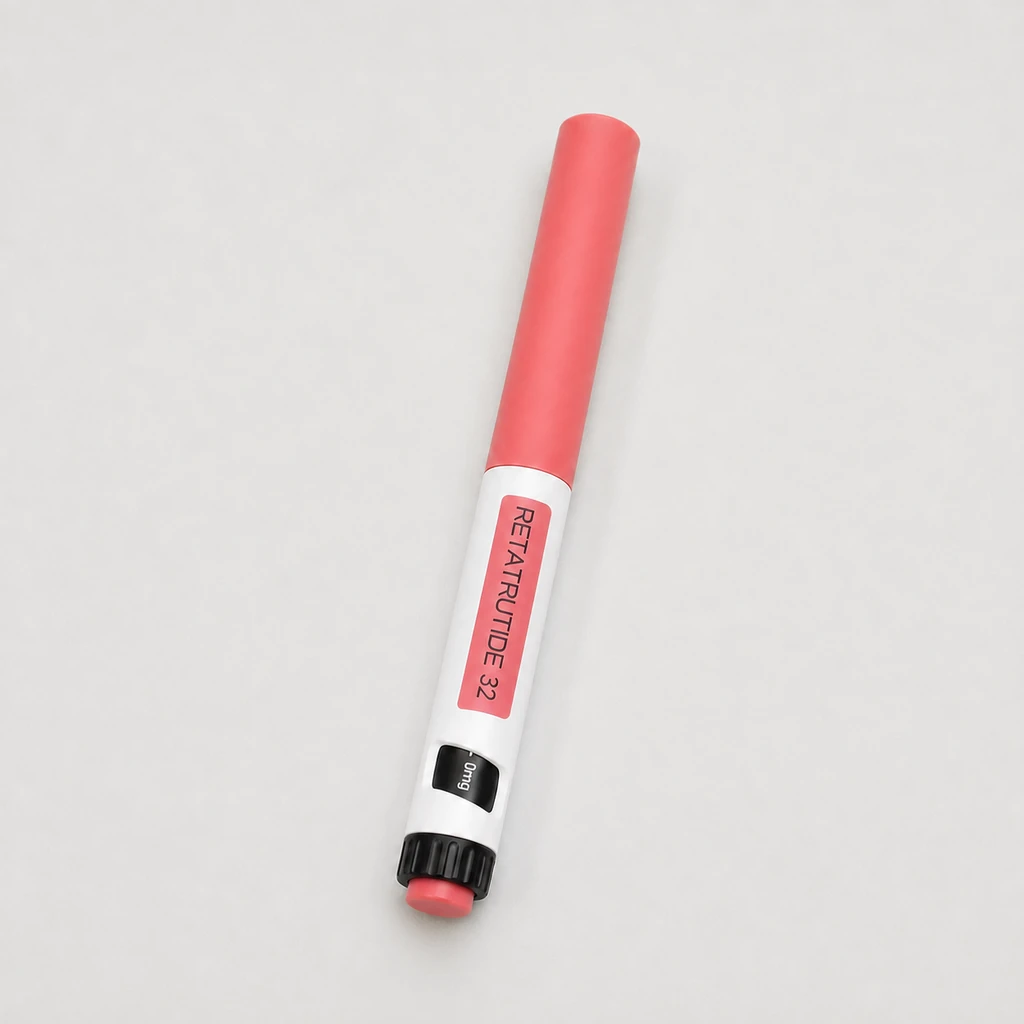
The Retatrutide 32 mg pen listing states declared total content. That number does not determine the molecule's half-life, a pen's expiry or the duration for which an opened product may be used.
Storage instructions concern the supplied formulation and container. Follow the exact information provided, and ask for clarification when it is missing. Our hotel-fridge guide helps organize practical storage questions; it does not assign a universal temperature excursion allowance to every peptide.
Before a procedure or a medicine change
Tell the treating team about all products and the dates they were used. Do this early, including before anesthesia or sedation. Do not calculate a personal waiting period by multiplying six days by a chosen number.
Professional anesthesia guidance explains why medicines that affect gastric emptying can require an individualized perioperative plan. That guidance should not be automatically transferred into a retatrutide stopping schedule. American Society of Anesthesiologists patient information.
The practical value of half-life is understanding persistence. The practical next step is a complete medication record and product-specific advice, rather than trying to infer a safe plan from a single pharmacokinetic number.
Instructions & useful references
- LY3437943 phase 1b studyThe Lancet Diabetes and Endocrinology / Duke Scholars · Early study in adults with type 2 diabetes; approximate six-day half-life. No individual administration or perioperative washout rule derived.
- GLP-1 medicines before surgeryAmerican Society of Anesthesiologists · Procedure-team assessment and individualized medication instructions; not a retatrutide-specific stopping rule.
Sources checked on October 9, 2026. This guide provides general information, with practical planning suggestions. It is not an individual treatment plan.