

Retatrutide at 104 Weeks: Who Was in the Extension?
Bali & IndonesiaPublished 3 min readcomparison

The 104-week retatrutide result came from a selected extension group. Understand who continued and why 30.3% is not a personal weight-loss forecast.
Illustrative stock photograph; not a customer, clinical result or product-testing record. · Photo: RDNE Stock project
The short answer
The reported 30.3% average weight reduction at 104 weeks came from a selected TRIUMPH-1 extension group. It was not the result for every person originally randomized. Understanding who could continue makes the number more useful than treating it as an expected result for a new buyer.
Table of Contents
- How the extension group was selected
- The percentage has a starting point
- Why subtracting two headlines can mislead
- A short checklist for long-term result claims
- What this means for a pen listing
- Sources
- Explore this topic
The reported 30.3% average weight reduction at 104 weeks came from a selected TRIUMPH-1 extension group. It was not the result for every person originally randomized. Understanding who could continue makes the number more useful than treating it as an expected result for a new buyer. [3]
How the extension group was selected
The sponsor reported 532 participants entering the extension. Eligibility included a starting BMI of at least 35, completion of the original 80 weeks and tolerability of the assigned treatment, with additional selection conditions. The extension added 24 weeks. [3]
This is a different question from “what happens to everyone who starts?” It asks what continued treatment looked like in a defined group who reached the extension. People who had already stopped or did not meet its criteria were not interchangeable with that group.
The percentage has a starting point
The 30.3% efficacy-estimand result was reported for participants who began with the 12 mg study assignment and continued at a maximum tolerated dose. It describes change from the study baseline, not another 30.3% lost during the additional 24 weeks. The corresponding treatment-regimen estimate was 29.9%. [3]
That distinction prevents a common arithmetic error. If a hypothetical person begins at 100 kg and a result describes 30% change from baseline, the reference remains the original 100 kg. It is not 30% of the weight at each successive visit. This example explains percentages; it does not predict anyone's outcome.
Why subtracting two headlines can mislead

Illustrative stock photograph; not a customer, clinical result or product-testing record. · Photo: Bich Tran
View full size ↗The 80-week headline and the 104-week headline do not necessarily describe identical participants under identical analysis conditions. Subtracting them is therefore not a reliable calculation of the average extra loss during the extension.
To calculate that change properly, you would want the extension participants' own measurements at both time points, using the same analysis. Without them, the subtraction answers a different question from the one it appears to answer.
A short checklist for long-term result claims
- Identify the original trial and the extension separately.
- Check who was eligible to continue and how many did.
- Find the baseline used for the reported percentage.
- Keep the analysis rule attached to the number.
- Look for tolerability and discontinuation information alongside weight.
These checks also help when comparing a two-year study with an eight-week testimonial. Time, population and measurement need to match before the numbers become comparable.
What this means for a pen listing
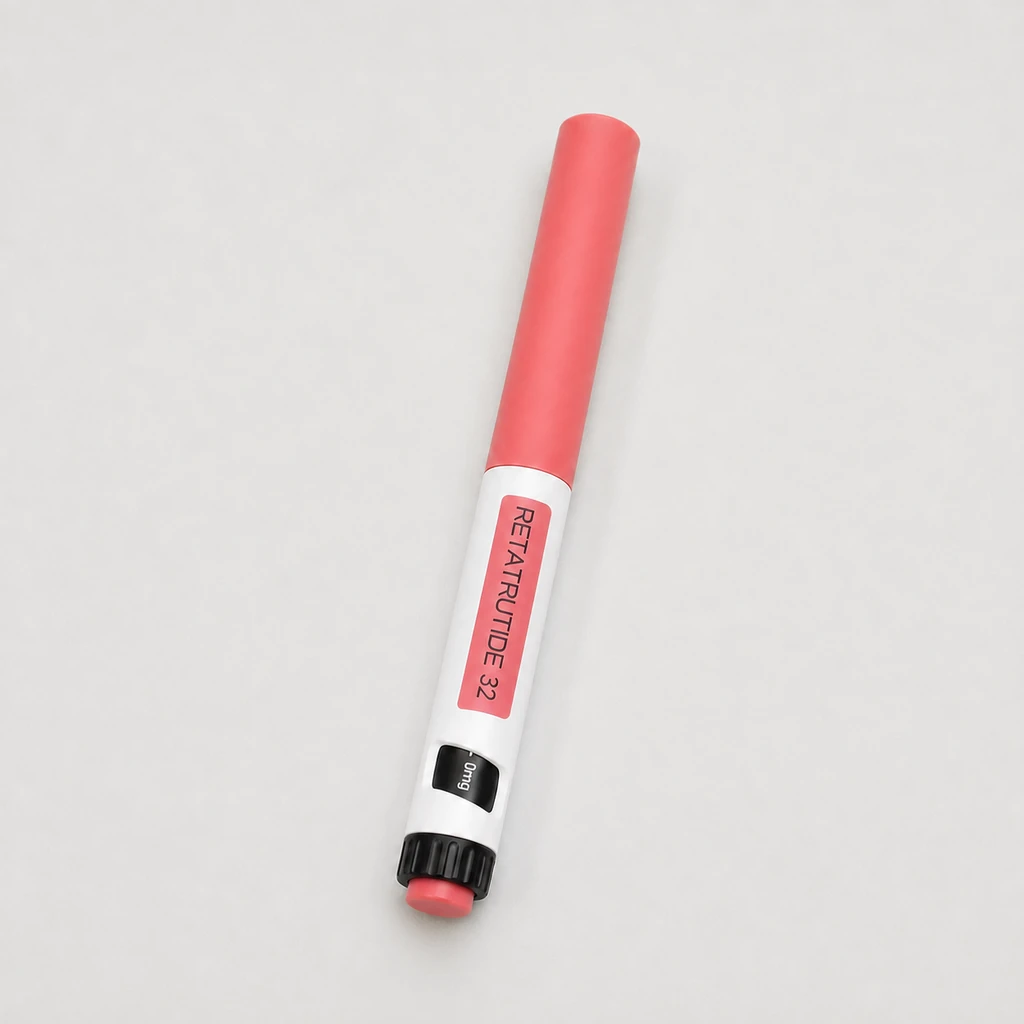
The store's 32 mg Retatrutide pen states total labelled contents. It does not represent a 104-week course, a trial dose or a guarantee of the extension result. [1]
Retatrutide remains investigational according to the sponsor. [2] The extension is valuable longer-term research, but the practical lesson for a reader is to keep the group and the time frame beside the headline, rather than convert a group average into an individual promise.
Instructions & useful references
- retatrutide product presentationPeptides in Bali · Actual labelled contents and presentation, not evidence of a clinical outcome.
- What to know about retatrutideEli Lilly and Company · Investigational status, triple receptor mechanism and absence of retail-product equivalence.
- Retatrutide TRIUMPH-1 and 104-week extensionEli Lilly and Company · 80-week efficacy and treatment-regimen estimands; selected 532-person extension population and 104-week results.
Sources checked on October 16, 2026. This guide provides general information, with practical planning suggestions. It is not an individual treatment plan.