

Raw vs Cooked Food Weight: Logging Meals Consistently
Everyday guidesPublished 5 min readcomparison
Match the measured preparation state to the nutrition entry or use a transparent batch calculation.
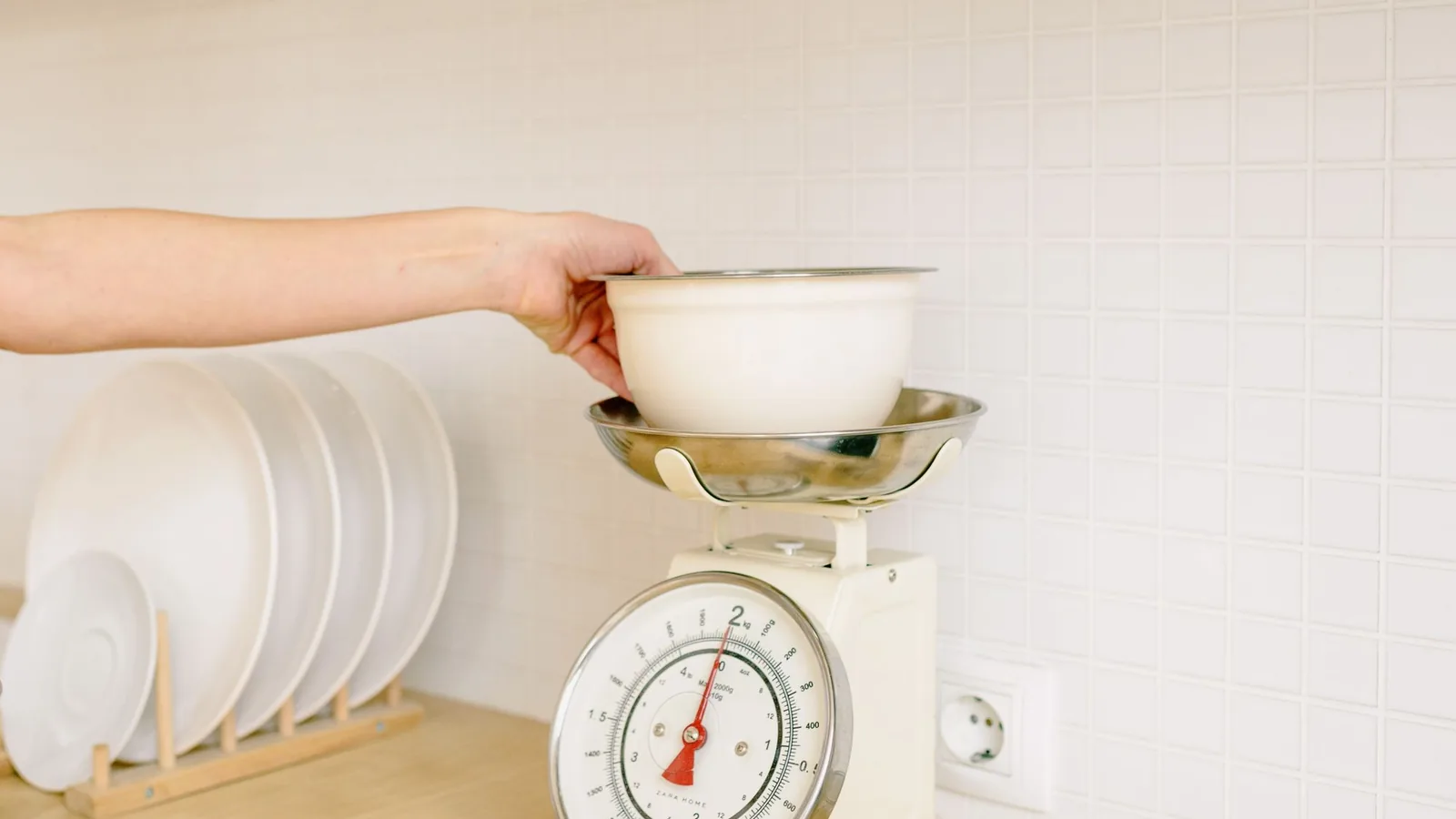
Raw ingredients on a kitchen scale; weighing is for consistent logging, not a rule for everyone. · Photo: Ksenia Chernaya · pexels.com
The short answer
Match the measured preparation state to the nutrition entry or use a transparent batch calculation.
Table of Contents
- Decide when you will measure
- Why the number on the scale changes
- A batch method for a homemade meal
- Include additions consistently
- Check packaged-food wording
- Make the record useful rather than exhausting
- Sources
- Explore this topic
When recording food, match the weight you measured to a nutrition entry in the same state: raw with raw, cooked with cooked. Cooking can change food weight through moisture and fat changes, so the same number of grams does not necessarily describe the same amount of food before and after cooking. There is no single conversion factor that works for every ingredient and method. [1]
You do not need to start weighing food because of this distinction. But if you already log meals for a specific reason, matching the entry to the measurement can prevent a basic error. A consistent approximate record is usually easier to interpret than a very detailed record built from mismatched entries.
Decide when you will measure
Choose the stage that is easiest to repeat. If you cook a meal for yourself, weighing ingredients before cooking may fit naturally into preparation. If you divide a cooked batch into portions, a batch method may be more practical. If someone else prepared the food, a matching cooked-food entry may be the only realistic option.
| What you measured | What the entry should describe |
|---|---|
| Raw food before cooking | The raw food in that form |
| Cooked food on the plate | The cooked food and relevant preparation method |
| A complete homemade batch | The ingredients used, then your share of the batch |
| A packaged prepared meal | The label's stated serving and preparation basis |
Check the details as well as the word “cooked.” Skin, bones, drained liquid and added ingredients can all affect what the entry represents. An entry for an edible portion should not be paired uncritically with a weight that includes parts you did not eat.
Why the number on the scale changes
USDA cooking-yield work measures changes in weight during particular cooking procedures. Its values are tied to foods and methods, rather than providing a universal raw-to-cooked multiplier. [1] A method that removes moisture and a method that adds water will not have the same result.
This is why copying a conversion from one meal to another can mislead. Even the same ingredient can finish at a different weight when cooked differently. A kitchen scale measures the current mass of the food; it does not tell you how much water was added or lost along the way.
Avoid treating the cooked weight as evidence that nutrients appeared or disappeared in direct proportion to the scale reading. The practical task is to use a matching data entry or a transparent recipe method, not to infer the entire nutritional change from weight alone.
A batch method for a homemade meal
Record the ingredients you actually use, including additions you want the log to capture. Once the meal is cooked, weigh the complete edible batch in a suitable container, subtracting the container's weight. Then record the portion you serve as a fraction of that batch.
For example, imagine a fictional batch weighing 1,200 grams after cooking. A 300-gram serving is one quarter of that batch. If the recipe calculation covers the whole batch, one quarter of its recorded nutrients is a practical estimate for that portion. This is arithmetic, not a claim about a real recipe.
The method assumes the mixture is reasonably evenly distributed. It is less precise when one portion contains most of the meat or tofu and another contains mainly sauce. Stir or portion thoughtfully where appropriate, and recognise that a homemade estimate still has limits.
Include additions consistently
Oil, sauces, milk and other ingredients can be easy to forget when attention is focused on the main food. Decide what level of detail serves your purpose and apply it consistently. Do not record a plain-food entry and then assume it describes a dish with several unrecorded additions.
At the same time, avoid chasing a level of precision the situation cannot support. Restaurant meals rarely come with the exact recipe and preparation weights. Use an appropriate estimate if you need one, and label it mentally as an estimate rather than repeatedly adjusting it to an imagined exact value.
If protein is the reason you are logging, the guide to how much protein per day provides the broader context. Improving an entry's consistency does not mean your target needs to become more rigid or that every meal must be weighed.
Check packaged-food wording
A package may provide information for the food as sold, drained or prepared according to specific instructions. Read that wording before entering a value. If you prepare it differently, the printed “as prepared” number may include ingredients or quantities you did not use.
Keep grams and millilitres separate unless you have a valid conversion for that food. A volume measure and a weight measure are not automatically interchangeable. Similarly, a scoop or cup can vary with how the food is packed, so use the measurement basis that matches the information you have.
Protein products add another distinction: quantity is not the same as type. The collagen versus whey comparison explains why two equal protein numbers can still represent different products. Correct arithmetic is useful, but it cannot replace reading what the food actually is.
Make the record useful rather than exhausting
Create a short note for meals you repeat: the product, preparation state and method you used. That prevents having to solve the same question every time. Update the note when the recipe or product changes instead of silently mixing old and new assumptions.
If logging makes eating increasingly stressful, restrictive or difficult, discuss that with a qualified professional. The purpose of a record should be clear and proportionate to your needs. You can stop using a method that is causing harm rather than pursuing an impossible level of precision.
For your next logged meal, check only three things: what was weighed, what the database entry describes and whether additions are included. Those checks address the main raw-versus-cooked problem without requiring a universal conversion chart or a completely new eating routine.
Instructions & useful references
- USDA Table of Cooking Yields for Meat and Poultry, Release 2USDA Agricultural Research Service · Method-specific cooking yields and weight change; no universal conversion claimed.
Sources checked on September 23, 2026. This guide provides general information, with practical planning suggestions. It is not an individual treatment plan.