

NAD+ Pen vs IV in Bali: What Actually Differs?
Bali & IndonesiaPublished 4 min readcomparison
Compare an NAD+ pen with an IV service in Bali: route, supervision, research and follow-up. Understand why equal milligrams do not prove equal outcomes.
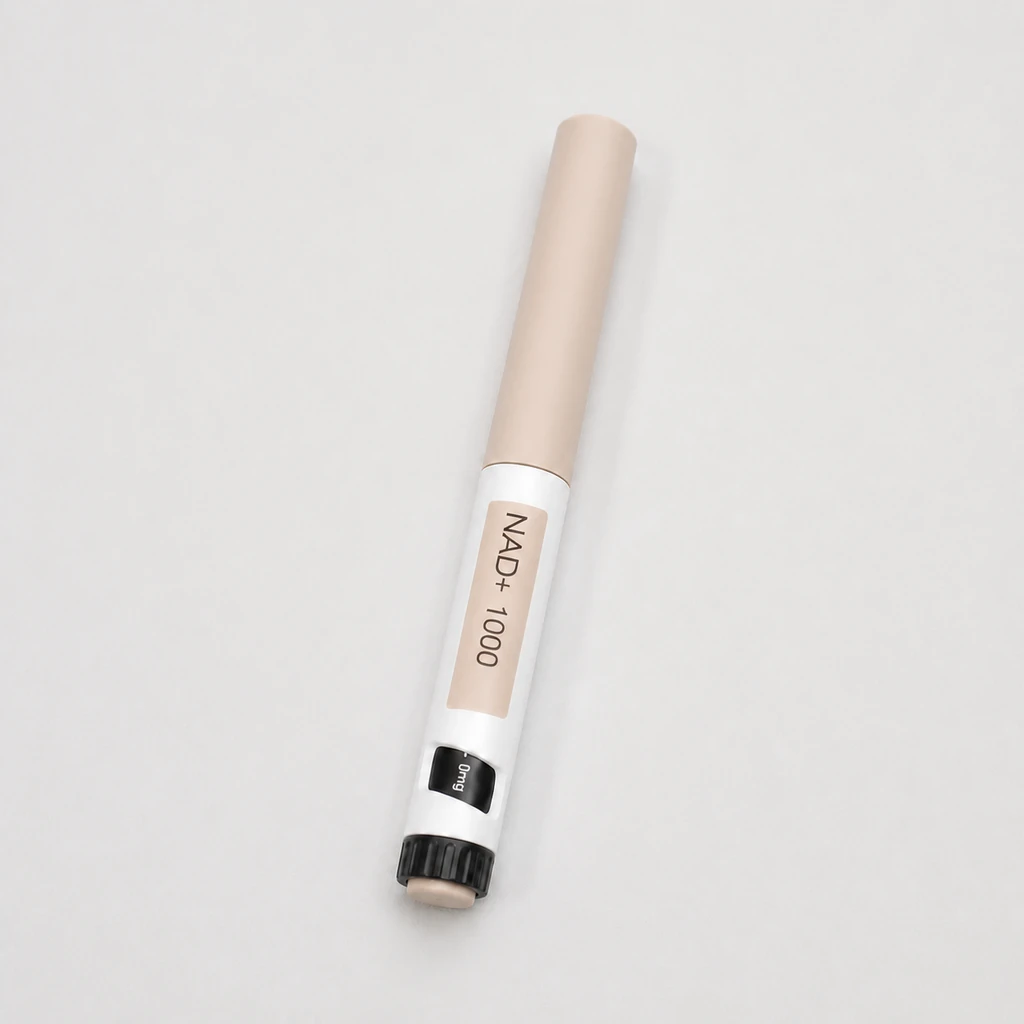
Existing catalogue image of the listed product; not a clinical-result photograph. · Photo: Peptides in Bali catalogue
The short answer
An NAD+ pen and an NAD+ IV appointment differ in route, preparation and care setting. The available studies cited here do not show that equal labelled amounts deliver equal results, so convenience should not be presented as clinical equivalence.
Table of Contents
- Compare the whole intervention
- What the human IV studies show
- Why matching milligrams is not enough
- What to ask an IV provider in Bali
- What convenience can and cannot tell you
- Frequently asked questions
- Sources
- Explore this topic
An NAD+ pen and an NAD+ IV appointment are different interventions, even when both mention the same molecule. The route, formulation, administration and surrounding care differ. There is no pen-versus-IV equivalence result in the studies discussed below, so a claim of “the same results in a different format” needs evidence of its own.
In Bali, search results can place a delivered pen beside a clinic or villa infusion service. Comparing them usefully means separating the physical product from the clinical service.
Compare the whole intervention
| Question | A pen listing | An IV service |
|---|---|---|
| What is offered? | A particular packaged product | A preparation administered within a service |
| What does the amount describe? | Usually total labelled contents | An amount associated with a planned session |
| Who assesses suitability? | Not established by the listing alone | Ask the provider who performs the assessment |
| Who monitors the intervention? | Requires a separate clinical arrangement | Ask who attends and how reactions are managed |
| What evidence is relevant? | Exact preparation and route | Exact IV preparation and clinical question |
The NAD+ pen page describes the store's format. It should be read as a product record, not as a substitute for an infusion provider's clinical plan.
What the human IV studies show
A 2019 pilot followed changes in NAD-related metabolites during an intravenous infusion. That study helps explain what researchers measured after IV administration; it did not compare an NAD+ pen with an infusion or establish a sustained everyday-energy benefit. Read the pilot study.
A 2026 retrospective study compared IV NAD+ and IV nicotinamide riboside in a commercial setting. It recorded differences in tolerability and infusion duration. It was not a randomized comparison of a pen against an IV and does not supply a conversion between them. Read the later study.
These papers answer narrower questions than most advertising headlines. They are useful precisely because the methods make those boundaries visible.
Why matching milligrams is not enough
The number on a pen may describe everything in the device. The number on an infusion menu may describe what the provider proposes for a session. Comparing those numbers as if they represent interchangeable experiences skips both the formulation and the route.
It also skips the outcome. “More NAD-related material measured in blood” and “less fatigue during ordinary work” are different claims. If the reason for considering either format is persistent tiredness, define that concern with a clinician before assuming which intervention addresses it.
You can use the same principle when comparing IVs with oral precursors. Our IV versus oral-precursor guide examines that separate question.
What to ask an IV provider in Bali
A useful enquiry should establish the service, not only an appointment slot. Ask who reviews medical history, which preparation is used, who administers it, how symptoms are monitored and what follow-up is available.
For a villa appointment in Seminyak or Berawa, also confirm that the location is suitable for the planned care. Accommodation access, privacy and the ability to respond to a problem are practical matters for the provider to resolve. A location pin alone does not answer them.
Do not assume that every provider offering “NAD therapy” uses the same compound or route. Ask the provider to distinguish NAD+ from related precursors and any other ingredients in the proposed preparation.
What convenience can and cannot tell you
A pen may look easier to fit around travel than a scheduled infusion. That is a practical observation, not proof that it produces the same exposure, benefit or risk.
If you already have a clinician's plan, tell them about the actual product or service under consideration. Ask whether a format change would alter the plan and which uncertainties remain. Do not create your own conversion from an infusion amount to pen use.
The product-details hub can help you find the catalogue information needed for that conversation.
Frequently asked questions
Is an NAD+ pen simply a portable IV?
No. A portable device does not reproduce an intravenous route or the clinical service around it.
Does an IV guarantee that I will feel more energetic?
A route of administration does not guarantee a subjective result. The studies above should be read for the outcomes they actually measured.
Does a larger labelled amount mean a better option?
It does not establish that. First identify whether the figure is total contents, a planned session or something else.
What should I compare first?
Start with the reason for considering the intervention, the exact route and who takes clinical responsibility. Compare device details after those questions are clear.
Instructions & useful references
- NAD+ metabolome during six-hour IV infusionGrant et al., Frontiers in Aging Neuroscience · Pilot metabolite study, not pen equivalence or long-term outcome evidence.
- IV NAD+ versus IV NR: retrospective tolerability pilotReyna et al., Frontiers in Aging · Small retrospective IV comparison; recorded tolerability differences, not pen-versus-IV efficacy equivalence.
Sources checked on October 19, 2026. This guide provides general information, with practical planning suggestions. It is not an individual treatment plan.