

How to Test a New Skincare Product Before Using It All Over
Everyday guidesPublished 5 min readhow to
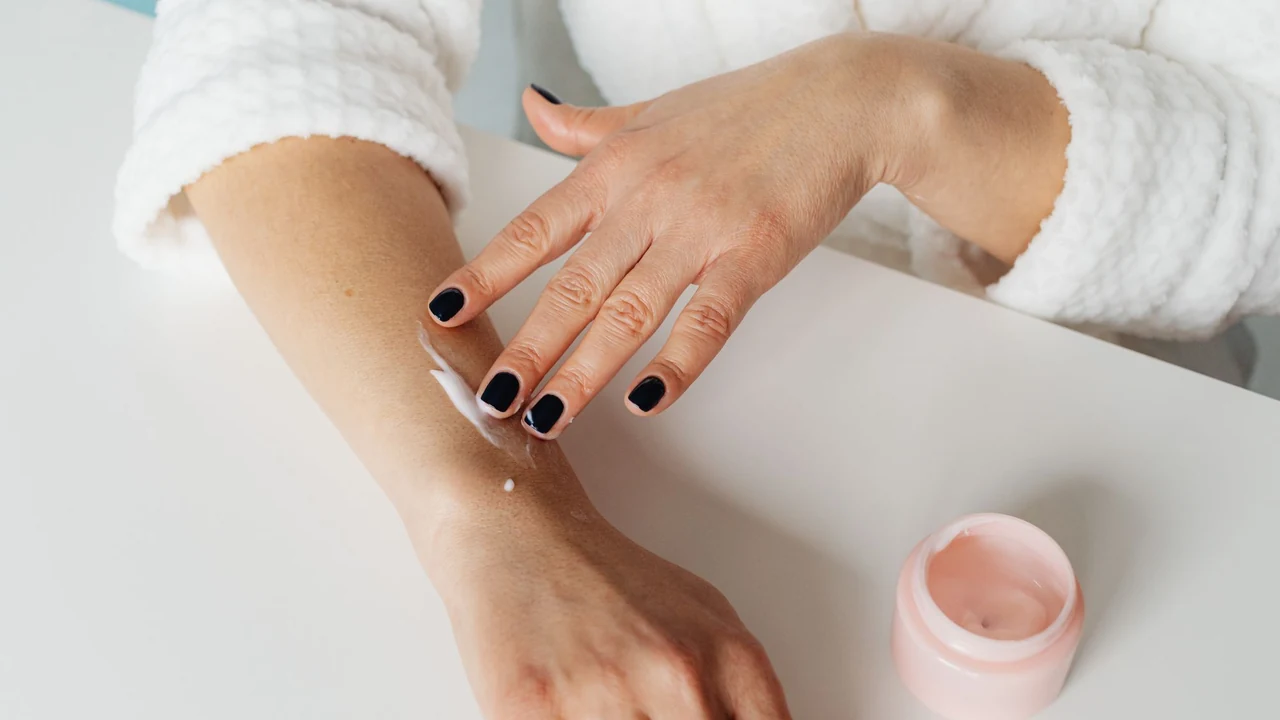
A small-area product test can reveal irritation, but it is not a diagnosis of allergy. Follow a clear introduction plan and keep a record you can actually interpret.
Illustrative licensed stock photograph. · Photo: https://kaboompics.com/ · pexels.com
The short answer
For an ordinary new skincare product, a small-area test can help reveal a reaction before wider use. Follow the product's directions; the American Academy of Dermatology describes testing suitable products over seven to ten days. A quiet test spot does not guarantee that your face will tolerate the product, and home testing does not replace clinical patch testing.
Table of Contents
- First, decide whether home testing is appropriate
- Write the introduction plan before starting
- Do not turn the test into a stress test
- Record what happened without diagnosing it
- A quiet test is a starting point, not a lifetime guarantee
- How clinical patch testing differs
- The decision to make at the end
- Sources
- Explore this topic
A new serum arrives just before a holiday. You want to know whether your skin likes it before putting it all over your face. That is a sensible question, but a quick dab behind the ear cannot provide a certificate of safety.
A home product test is a limited observation of one product on one small area. It can help you notice a reaction. It cannot diagnose an allergy, promise that repeated facial use will be comfortable or tell you whether the product will achieve its advertised result.
First, decide whether home testing is appropriate
Read the directions and warnings before opening the bottle. Check that you know the product's name, intended use and ingredient list. Do not test an unlabelled decant when you cannot establish what it contains.
This guide concerns introducing ordinary skincare. Prescription treatments, products your clinician has told you to avoid and known allergens need their own instructions. Do not use a home test to overrule those instructions.
The American Academy of Dermatology's product-testing guidance describes applying a normal amount to a small area, such as the underside of the arm, twice daily for seven to ten days. For products meant to wash off, use the specified contact time. This general method is not permission to apply a strong active more often or leave it on longer than its label allows. Stop and wash off a product that causes a reaction; severe or persistent symptoms need medical assessment.
Write the introduction plan before starting
The most useful preparation is a short record. A photograph of the front label alone is not enough if several similarly named products exist.
| Record | Example of a useful entry | Why it helps |
|---|---|---|
| Exact product | Full name, strength if stated, version | Avoids confusing two formulas |
| Directions | Leave on; specified frequency | Keeps the test tied to intended use |
| Test location | A clearly identified small area | Makes repeat observations comparable |
| Other new products | None introduced during this observation | Reduces ambiguity |
| Start and observations | Date, time, appearance and sensation | Gives a history beyond “it reacted” |
The examples are a way to organise information, not a personalised treatment schedule. Keep your established routine as consistent as practical while you observe the new item. Starting a cleanser, acid, serum and moisturiser together makes any later detective work much harder.
Do not turn the test into a stress test
More product is not a more convincing test. Neither is covering an ordinary leave-on product with an improvised airtight dressing, applying it to already irritated skin or deliberately combining it with something that the manufacturer says to avoid.
The question is how a suitable product behaves under its intended conditions. If you change those conditions dramatically, the result may not answer the question you started with.
For a product combination, check the actual formulas separately from tolerability. A comfortable small-area test does not erase an explicit incompatibility warning. Our guide to peptides and retinol explains why product instructions matter more than a universal layering chart.
Record what happened without diagnosing it

Illustrative licensed stock photograph. · Photo: SHVETS production · pexels.com
View full size ↗Useful notes are specific: “itching began that evening at the application area” or “the area looked unchanged on the next morning.” Less useful notes are conclusions such as “allergic to all preservatives” based on one product.
A simple daily entry can contain:
- When you applied it and whether you followed the directions.
- What you noticed before and after application.
- Whether the change stayed within the test area.
- Anything else that changed, such as another product or friction.
- Whether you stopped and what happened afterwards.
A photograph can supplement those notes if taken in similar light. It does not establish a diagnosis. Keep the packaging so a professional can identify the ingredients if needed.
A quiet test is a starting point, not a lifetime guarantee
If there is no observed reaction, that is useful information about the conditions you tested. It is not proof that every amount, combination or body area will behave identically.
Introduce the product according to its instructions rather than making up for the testing period with extra applications. Keep the rest of the routine understandable. You do not need to add another active immediately because the first test appeared uneventful.
If your main problem is tightness after cleansing, a more complicated routine may not be the next useful experiment. Start with the practical issues in applying moisturiser to damp skin.
How clinical patch testing differs
The British Association of Dermatologists describes specialist patch testing used to investigate contact allergy. Selected substances are applied and the skin is assessed at arranged follow-up visits. It is a diagnostic process, not a larger version of a home cosmetic trial.
Bring your product list and reaction history to a consultation. Do not buy concentrated ingredients and attempt to recreate clinical testing yourself. A negative experience with one formula also does not identify which ingredient caused it.
The decision to make at the end
Keep the conclusion narrow: “No reaction observed under these conditions,” “Stopped because of these symptoms,” or “Need advice before continuing.” That is more useful than labelling the product universally safe or universally harmful.
A good introduction process leaves you with fewer unknowns, the original label and a readable record. It should not leave you pushing through a reaction to finish an arbitrary challenge.
Instructions & useful references
- How to test skin care productsAmerican Academy of Dermatology · Small-area introduction;7–10days; normal amount; rinse-off instructions; stop for reaction; distinct clinical patchtesting.
- Patch testingBritish Association of Dermatologists · Specialist contact-allergy testing; arranged patch application and later readings; not a home cosmetic test.
Sources checked on September 28, 2026. This guide provides general information, with practical planning suggestions. It is not an individual treatment plan.