

How to Read a Peptide COA: Purity, Batch and Test Results
Everyday guidesPublished 7 min readhow to
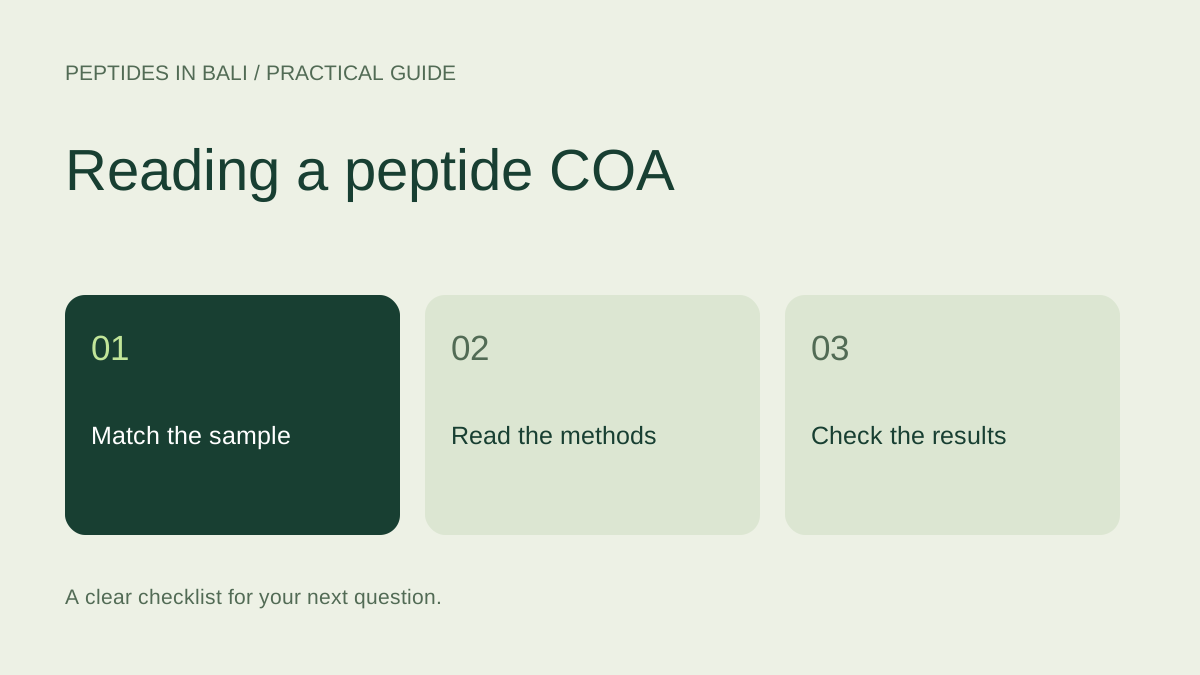
Read a peptide certificate of analysis with confidence: check batch details, purity versus content, test methods and the questions to ask about a report.
Original explanatory illustration.
The short answer
Match the report to its sample and batch, then read methods, units, results and specifications. Purity, identity, content and sterility are separate questions; a COA does not establish product approval.
Table of Contents
- What should a peptide COA tell you?
- Purity, content and identity answer different questions
- What do HPLC and mass spectrometry mean here?
- Does a COA prove sterility?
- How to check that the report belongs to the product
- A message you can send when requesting documentation
- A COA and a product registration are separate checks
- Common questions
- Sources
- Explore this topic
A peptide certificate of analysis, or COA, is useful when you can connect the report to the exact sample or batch and understand which tests were performed. Start with the product identity, batch number, laboratory and report identifier. Then read the results together with their methods, units and acceptance criteria. A large purity percentage by itself leaves most of those questions unanswered. [1]
You do not need to become an analytical chemist to ask a better question. The goal is to know what the document supports, what still needs an explanation and whether the supplied report belongs to the product you are considering.
What should a peptide COA tell you?
WHO's model certificate includes the sample and product description, batch information, the issuing laboratory, the tests performed and their results against the stated specifications. It is a model for presenting analytical information, not a WHO endorsement of any product displaying a similar layout. [1]
For a first pass, use this reading order:
| Read this first | What to compare or ask |
|---|---|
| Product or sample name | Does it identify the same ingredient and presentation? |
| Batch or lot number | Does it match the pack, or is the relationship documented? |
| Laboratory and report ID | Can the issuer confirm that the report is genuine? |
| Sample receipt and test dates | What material was received and when was it tested? |
| Methods and results | Which questions were actually measured? |
| Specifications | What limits or criteria were used to assess the result? |
| Full document | Are all pages, qualifications and explanatory notes included? |
If you receive only a cropped screenshot, ask for the complete report. A crop may remove the sample description, the units or a qualification that changes how a number should be read. A visually tidy document and a useful document are not necessarily the same thing.
Purity, content and identity answer different questions
Purity describes the target peptide relative to other material measured by a particular analytical approach. Peptide content concerns how much peptide material the sample contains. Identity concerns what the material is. Those questions are related, but a result for one does not automatically fill in the others. GenScript's technical guidance specifically distinguishes peptide purity from net peptide content. [2]
Suppose a fictional report shows “purity: 99%” beside a product advertised as 10 mg. You cannot conclude from that percentage alone that the container holds exactly 9.9 mg of the advertised peptide. You would need to understand the analytical basis, the measured content and what the stated container amount represents.
The useful follow-up is precise: “Does this report include an identity result and a quantitative content or assay result for this presentation?” That is much easier for the issuer to answer than “Is it good quality?”
What do HPLC and mass spectrometry mean here?
HPLC separates components under a specified method. The detector produces a chromatogram, often displayed as peaks. Mass spectrometry adds information about molecular mass and can support identification. Waters' peptide-analysis work shows how chromatographic separation and mass data are used together for identity checks and impurity profiling. [3]
A reader does not need to identify a molecule by looking at the tallest peak. Instead, check whether the report states the method and provides an interpretation from the laboratory. Ask what the reported percentage refers to and which sample was tested.
Likewise, a single chromatogram image is not a universal record of everything that might be in a product. Methods have a defined scope. If your question is about a different property, look for the test that addresses it rather than reading that property into the graph.
Does a COA prove sterility?
A purity or identity result is not itself a sterility result. Sterility and bacterial endotoxin testing are separate analytical areas; USP publishes distinct chapters for them. Look for the relevant test, method and result rather than assuming that the word “tested” covers every quality question. [4] [5]
Also ask which stage was sampled. A report about starting material does not, by itself, describe everything that happened when that material was put into a finished container. The sample description and traceability matter as much as the document's headline.
This is a reason to request the right information, not to invent a universal checklist of tests that every unrelated product must use. The appropriate quality requirements depend on the product, its intended use and the applicable standards.
How to check that the report belongs to the product
Put the product label and report next to each other. Compare the ingredient name, any listed form, batch number and presentation. If the report uses a different internal sample code, ask how that code maps to the product batch. Save the explanation with the document.
If the laboratory offers a report-verification service, reach it through the laboratory's own published contact details or official site. Do not rely only on a contact address typed into an image. Provide the report identifier and ask the issuer what it can confirm; the laboratory may have limits on information it can disclose about a client's sample.
A QR code is a convenient link, not an independent quality test. Check where it leads and whether the resulting page identifies the same report. A link to a seller's homepage does not verify a specific analytical result.
A message you can send when requesting documentation
You can use this wording with the product name filled in:
“Please send the complete analysis report available for this product, including its report ID, sample description, batch reference, methods and results. Please explain how the tested sample relates to the batch supplied, and whether the report concerns starting material or the finished product.”
For a catalogue enquiry, ask the Peptides in Bali manager which documents are available for the exact product under discussion. Availability of a document should be confirmed rather than assumed for every listing or batch.
Keep the answer with the full document and a photograph of the packaging. That gives you one coherent record instead of scattered screenshots from different conversations.
A COA and a product registration are separate checks
An analytical report describes testing. It does not by itself grant marketing authorization, establish a medical indication or decide whether a product is appropriate for a person. In Indonesia, BPOM's consumer guidance uses the Cek KLIK checks: packaging, label, marketing authorization and expiry. [6]
When a seller claims a registration, verify the exact product details in the official system. A company name or another product's registration is not a substitute for a match. Our Bali peptide buying guide explains the practical order and delivery questions separately.
Common questions
Is 99% purity the same as 99% of the vial being active ingredient?
Not necessarily. Purity and peptide content describe different analytical questions. Read the method and the basis of the result, then ask whether quantitative content was measured. Do not calculate a container's active amount from a purity headline alone.
Can one certificate cover every batch?
A report has a stated sample and scope. Ask how it relates to the batch being supplied rather than assuming a general document covers later material. A matching name without a clear batch relationship leaves that question open.
Is an old report automatically invalid?
Age alone does not answer whether it applies. Check the sample, batch, dates, expiry or retest information where relevant, and the issuer's explanation. A recent report for a different sample may be less relevant than an older report that actually matches.
Does a COA tell me how to use a peptide?
No. It is an analytical document. It does not provide an individual treatment plan, dose or switching instruction. Keep questions about product testing separate from questions about medical suitability and use.
Instructions & useful references
- Model certificate of analysisWorld Health Organization · Sample, batch, laboratory, tests, specifications and results; model is not product endorsement.
- Peptide content and purity definitionsGenScript technical documentation · Distinction between net peptide content, gross material and purity.
- LC-MS workflow for synthetic peptide impurity analysisWaters · Chromatography and mass information in identity and impurity assessment.
- General chapter 85: bacterial endotoxins testUnited States Pharmacopeia · Scope of bacterial endotoxins testing; distinct from sterility testing.
- General chapter 1071: sterility test contextUnited States Pharmacopeia · Identifies the separate sterility test chapter 71 and the importance of sterility assurance.
- Cek KLIK consumer product checksBPOM Indonesia · Packaging, label, marketing authorization and expiry checks.
Sources checked on September 17, 2026. This guide provides general information, with practical planning suggestions. It is not an individual treatment plan.