

HbA1c vs Fasting Glucose: Tests, Units and What to Ask
Everyday guidesPublished 5 min readcomparison
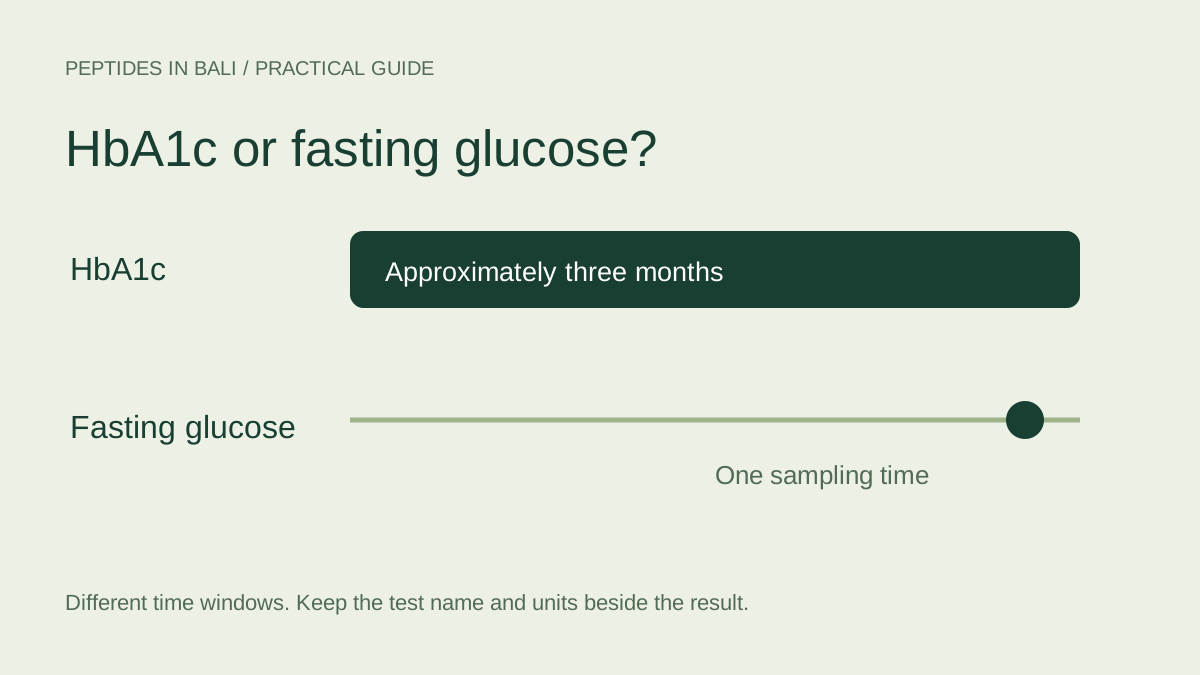
Understand HbA1c vs fasting glucose, preparation, units and non-pregnancy thresholds. Use a practical checklist for your next blood-test appointment.
Original explanatory illustration; not a patient result.
The short answer
HbA1c reflects roughly three months of glucose exposure; fasting plasma glucose measures one sampling time. Preparation, units, test limitations and clinical confirmation matter.
Table of Contents
- HbA1c versus fasting glucose at a glance
- What do the usual thresholds mean?
- Check the units before comparing reports
- Why might HbA1c and fasting glucose disagree?
- Preparing for a blood test in Bali
- Five questions to ask when the results arrive
- How this relates to weight-management decisions
- Sources
- Explore this topic
HbA1c and fasting glucose measure different aspects of blood sugar. HbA1c reflects average glucose over roughly the previous three months and usually does not require fasting. A fasting plasma glucose test measures the level at the time of the blood draw, after the instructed fast. One is not simply a more detailed version of the other. [1]
If you are looking at a health-check package in Bali, find out which test it includes, how to prepare and who will explain the result. A number without the test name and units is easy to misread.
HbA1c versus fasting glucose at a glance
| Detail | HbA1c | Fasting plasma glucose |
|---|---|---|
| What it describes | Glucose exposure over approximately three months | Glucose at the time of sampling |
| Usual preparation | No fasting needed for this test alone | At least eight hours fasting, following the laboratory's instructions |
| Common units | Percentage; some laboratories use mmol/mol | mg/dL or mmol/L |
| Important context | Red blood cell and hemoglobin-related factors can affect accuracy | Fasting conditions and the timing of the sample matter |
| What follows an abnormal result | Clinical interpretation, often confirmation | Clinical interpretation, often confirmation |
Ask about the entire panel. HbA1c may not require fasting, but another test booked for the same blood draw might. Do not assume the easiest preparation rule applies to all the tests on the request. [1]
What do the usual thresholds mean?
The following non-pregnancy thresholds are those presented by NIDDK using American Diabetes Association criteria. They help explain a laboratory report; they do not diagnose a reader or replace local clinical interpretation.
| Category in that framework | HbA1c | Fasting plasma glucose |
|---|---|---|
| Below the prediabetes range | Below 5.7% | Below 100 mg/dL |
| Prediabetes range | 5.7–6.4% | 100–125 mg/dL |
| Diabetes range | 6.5% or higher | 126 mg/dL or higher |
A clinician usually confirms a diabetes diagnosis with a second test. Pregnancy uses different testing pathways and may use different cutoffs. A home glucose meter cannot establish the diagnosis by itself. [1]
This is why the next step after a result is not to choose a product from a threshold table. The clinician needs the test, the circumstances, symptoms if present, and any other relevant findings.
Check the units before comparing reports
Fasting glucose may appear as mg/dL on one report and mmol/L on another. To convert glucose approximately, divide mg/dL by 18 to obtain mmol/L, or multiply mmol/L by 18 to obtain mg/dL. For example, 108 mg/dL is approximately 6.0 mmol/L. That is a unit conversion, not a diagnosis. [2]
HbA1c percentages cannot be converted with that formula. HbA1c reported in mmol/mol also differs from glucose reported in mmol/L. Keep the full unit beside every copied value.
A useful note has four parts: test name, result, unit and date. “My glucose was six” loses information. “Fasting plasma glucose, 6.0 mmol/L, sampled on this date” is much easier to discuss accurately.
Why might HbA1c and fasting glucose disagree?
The tests cover different time windows, so identical-looking conclusions are not guaranteed. HbA1c also depends on the red blood cells involved in the measurement. Certain types of anemia, hemoglobin variants and other circumstances can affect how reliable it is. If the tests do not fit together, the clinician may repeat testing or choose another approach. [3]
A mismatch is useful information to bring to an appointment. It is not a reason to keep whichever result you prefer and discard the other. Bring both original reports, including the reference ranges and any laboratory comments.
Recent changes in eating, exercise or medicines should also be part of the conversation. A longer-term marker is not designed to prove that yesterday's routine worked, while one fasting result does not describe every glucose level throughout the day.
Preparing for a blood test in Bali
Confirm the instructions directly with the clinic or laboratory. For a fasting glucose test, ask when to stop eating, what you may drink and how the appointment time affects the fast. NIDDK describes fasting as no food or drink except water for at least eight hours. [1]
Do not independently stop prescribed medicines to improve a test result. Ask the prescribing clinician or laboratory what to do with your usual medicines on the day, especially when medication and fasting may interact.
Take a list of the medicines and supplements you use, and mention any relevant blood condition, recent transfusion or pregnancy. These details help the clinician decide which results can be interpreted in the usual way. [3]
If you are flying into Bali just before the appointment, keep the timing simple enough to follow. A fasting instruction tied to the wrong time zone can be confusing. Ask the clinic to give you the local start time rather than improvising during the journey.
Five questions to ask when the results arrive
- Which test was performed, and was the preparation appropriate?
- What do the units and reference range on this specific report mean?
- Does the result need confirmation or a different test?
- Could any medicine, blood condition or other circumstance affect interpretation?
- What is the agreed next step and when should it happen?
Save the answer beside the report. That is more useful than collecting repeated tests with no plan for reviewing them.
How this relates to weight-management decisions
Glucose testing and a weight-management consultation can overlap, but the test does not select a medicine or dose on its own. Our tirzepatide-versus-semaglutide guide explains the separate questions involved in comparing treatment options.
Likewise, a food plan should fit your circumstances rather than be reverse-engineered from one number. The Journal contains practical nutrition and routine guides you can use to prepare questions, while a clinician interprets your results in context.
Can I have coffee before a fasting glucose test?
Follow the laboratory's fasting instructions. NIDDK's definition allows water, not coffee. If you already drank something else, tell the laboratory rather than quietly treating the sample as fasting.
Can a normal HbA1c rule out every glucose problem?
No single test answers every possible question. Symptoms, pregnancy, test limitations and mismatched results can change the investigation. Ask which test is appropriate to the concern you are trying to resolve.
Instructions & useful references
- Diabetes tests and diagnosisNIDDK · Fasting requirements, A1C time window, non-pregnancy ADA thresholds, confirmation and home-meter limitation.
- Blood glucose unit conversion chartJoslin Diabetes Center · 1 mmol/L glucose equals approximately18 mg/dL; not an HbA1c conversion.
- The A1C test and diabetesNIDDK · Accuracy, blood conditions, discordant results and red blood cells.
Sources checked on September 18, 2026. This guide provides general information, with practical planning suggestions. It is not an individual treatment plan.