

GHK-Cu for Skin: Serums, Routines and Injection Differences
Everyday guidesPublished 8 min readhow to
A practical GHK-Cu skincare guide: read the label, compare topical and injectable formats, check combinations and build a routine you can evaluate.
The short answer
For skincare, identify a finished topical formula and follow its own directions. A copper-peptide serum and injectable GHK-Cu are different formats; serum percentages and routines do not supply injection instructions. [1] [2]
Table of Contents
- What does GHK-Cu mean on a skincare label?
- Serum, cream or injectable: why the format matters
- How can you add a copper-peptide serum to a simple routine?
- Can you use GHK-Cu with retinol or vitamin C?
- How long should you give it before judging the result?
- What matters in Bali's sun and humidity?
- What should you ask before buying?
- Sources
- Explore this topic
- Recommended
GHK-Cu is a copper peptide found in some skincare products. If you are looking for a way to add it to a routine, start by identifying the format: a cosmetic serum applied to skin and a product intended for injection are different categories, with different instructions and evidence. A claim made for one cannot simply be transferred to the other.
For someone shopping for skincare, the useful questions are concrete. What is in the bottle? How does the manufacturer say to use it? Does it fit with the products already on your shelf? What would count as an improvement, and how will you tell whether your skin is tolerating it?
What does GHK-Cu mean on a skincare label?
GHK-Cu refers to a copper complex of a short peptide. In cosmetic ingredient lists, you may see Copper Tripeptide-1 rather than the abbreviation on the front of the bottle. For example, The Ordinary lists Copper Tripeptide-1 among the ingredients in its Multi-Peptide + Copper Peptides 1% Serum. [1]
Read the ingredient list and directions together. A product can contain copper peptides alongside humectants, other peptides and ingredients that affect its texture or how it feels on the skin. The full formula matters; an ingredient name alone does not tell you the concentration, the finished product's performance or whether you will find it comfortable.
A useful label check records the exact product name, the intended route, the directions and any restrictions. Keep a photograph of the packaging so you can check those details after discarding the box. This also avoids confusing a similarly named product when you repurchase.
Serum, cream or injectable: why the format matters
| Format you are looking at | What to check | What you should not assume |
|---|---|---|
| Finished cosmetic serum | Ingredient list, facial application directions and the manufacturer's compatibility advice | That the ingredient alone explains every advertised result |
| Finished cosmetic cream | Directions, the rest of the formula and whether it suits the texture you want | That a richer texture means a stronger copper-peptide effect |
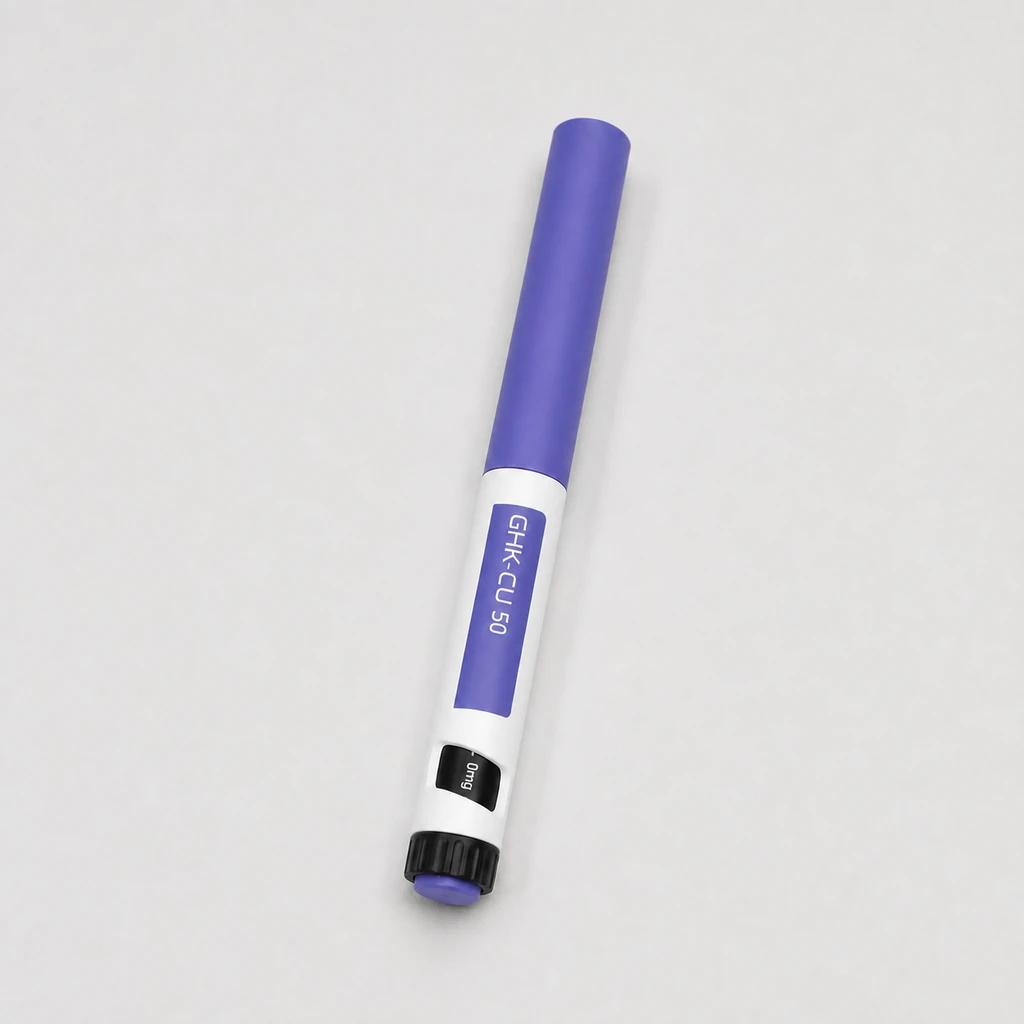
| Vial or pen described for injection or research | The product's actual classification and route; obtain medical guidance for questions about injecting | That a skincare routine or serum study supplies injection instructions |
| Raw powder or ingredient concentrate | Its intended purpose and documentation | That it is a finished facial product ready to mix at home |
Topical and injectable routes should not be presented as stronger and weaker versions of the same skincare routine. The FDA specifically flags potential safety issues and limited human safety data for injectable GHK-Cu in the compounding context. That information does not mean an ordinary cosmetic serum has the same risk profile; it means the routes cannot be treated as interchangeable. [2]
If your goal is a skincare routine, use the instructions for a finished topical product. There is no sensible reason to calculate an injection amount from the percentage on a serum bottle. This guide does not provide injection doses or instructions for turning a research material into a cosmetic.
How can you add a copper-peptide serum to a simple routine?
Start with the manufacturer's directions for the product you actually have. One brand's advice about frequency or combinations may not apply to another formula. The Ordinary, for example, directs users of its named serum to apply a few drops morning and evening and to use it only on unbroken skin. That is an instruction for that product, not a universal schedule for every copper serum. [1]
Before applying a new product widely, the American Academy of Dermatology recommends testing it on a small area twice daily for seven to ten days, using it as directed. Stop if the area becomes irritated. A home use test cannot guarantee that a later reaction will never occur, but it gives you a chance to notice a problem before adding the product to your whole face. [3]
Once you have checked tolerance, keep the surrounding routine easy to follow. For example, write down your cleanser, the new product, your usual moisturiser and your daytime sunscreen. Place each step according to the product instructions rather than adding several extra actives because you are already changing the routine.
Use the label checklist below before you begin. Its purpose is to catch missing information, not to score the serum or tell you that it will work for your skin.
Make it useful
Check the label before changing your routine
Use this for a finished topical cosmetic. Tick only the details you have actually checked.
0 of 5 details checked.
Completing this list is not a safety certification or a prediction of results. Stop a product that irritates your skin and seek appropriate advice.
Your entries stay in this page. This tool does not save or send them. Refreshing clears the tool; keep a separate record if you need it later.
Can you use GHK-Cu with retinol or vitamin C?
There is no dependable yes-or-no rule covering every formula sold as a copper-peptide serum. “Vitamin C” can refer to different ingredients, while a retinoid product may have its own specific instructions. The useful starting point is the exact pair of products and their manufacturers' directions.
If your copper-serum instructions advise against a combination, follow that restriction. If the labels do not resolve the question, ask the manufacturer or a dermatologist using the full product names. Advice about two named products is more useful than a blanket rule about everything sold under “peptides” and “vitamin C.”
When organising the routine, make a small inventory:
| Product already in use | Information to write down |
|---|---|
| Retinol or prescription retinoid | Exact name, strength if stated and directions from the label or prescriber |
| Vitamin C product | Full name and the vitamin C ingredient listed on the pack |
| Exfoliating product | Whether it is a leave-on treatment or a wash-off product, plus its directions |
| Copper-peptide product | Full formula name, application frequency and any combination restrictions |
Do not guess that separating products by a few minutes makes a prohibited combination appropriate. If a label says to avoid combining them, a self-invented waiting time does not override it. For a prescribed skin treatment, ask before changing the routine around it.
How long should you give it before judging the result?
A universal “GHK-Cu works in X days” promise would need evidence for the exact product and the outcome being measured. A smoother feel after application, a change in dryness and a change in the appearance of lines are different observations. They should not be collapsed into one countdown.
Pick a specific question before you start, such as whether your skin feels less tight or whether the product sits comfortably under moisturiser. Take an initial photograph in ordinary, even lighting. If you take later pictures, keep the room, camera distance, angle and expression similar. Disable beauty filters and avoid comparing a morning photograph in shade with a heavily lit evening photograph.
For a simple record, use three columns: date, products used and what you noticed. Include irritation as well as changes you like. If you introduce a serum, a new moisturiser and an exfoliating treatment together, the record may show a change without showing which product caused it.
There is no need to keep using a product that is causing a reaction in order to reach an arbitrary deadline. Stop the new product if it irritates your skin and seek advice if the reaction is significant or does not settle. [3]
What matters in Bali's sun and humidity?
A copper-peptide serum does not replace sunscreen. The American Academy of Dermatology recommends a broad-spectrum, water-resistant sunscreen with SPF 30 or higher, alongside shade and protective clothing. A serum described as “repairing” does not supply that protection unless the finished product is also labelled and tested as sunscreen. [4]
For the rest of the routine, comfort and practicality matter. If a heavy combination feels unpleasant in humid weather, check whether you are layering more products than you need. Keep skincare out of a hot parked vehicle and follow its own storage directions; do not transfer medicine-fridge rules to a cosmetic without checking the label.
When packing, keep the original label readable and close the container properly. For an injectable medicine that also needs to travel with you, use its separate handling instructions. Our guide to travelling with pens in Bali covers that different task.
What should you ask before buying?
Ask for the complete label and directions rather than relying on the front-panel ingredient name. If a claim interests you, ask whether it concerns this finished formula, a different product or the ingredient generally. A seller should be able to make that distinction clearly.
Be particularly careful with percentage comparisons. A number can describe an ingredient, a blend or something else defined by the manufacturer. Two large numbers printed on two bottles do not establish a meaningful strength ranking unless they describe the same thing in a comparable formula.
For our own listings, the product catalogue is where you can check the stated format and pack details. Use contact for a specific label or order question, and the FAQ for site and delivery information. These details help you identify the product; medical questions about injecting, reactions or suitability belong with a qualified clinician.
The best starting point is a product whose identity and directions you can verify, introduced into a routine simple enough to evaluate. That gives you a practical way to decide whether a topical copper-peptide product belongs on your shelf, without treating a percentage, a before-and-after photograph or an injection claim as the answer.
Instructions & useful references
- Multi-Peptide + Copper Peptides 1% Serum: ingredients and directionsThe Ordinary / DECIEM · Copper Tripeptide-1 in the full formula; exact product directions and unbroken-skin restriction. Not universal instructions for other products.
- Certain substances used in compounding that may present significant safety risksUS Food and Drug Administration · GHK-Cu for injectable routes: potential immunogenicity concerns and limited human safety data; do not transfer this classification to cosmetic serums.
- How to test skin care productsAmerican Academy of Dermatology · Small-area product use test for seven to ten days and stopping if irritation develops.
- How to select a sunscreenAmerican Academy of Dermatology · Broad-spectrum, water-resistant sunscreen, SPF 30 or higher.
Sources checked on September 16, 2026. This guide provides general information, with practical planning suggestions. It is not an individual treatment plan.
Explore this topic
Keep reading
- Travelling with Peptide Pens: Bali Storage & Flight Guide
Prepare travel and product handling separately from your skincare routine.